sound healing: why music can change the way you feel
There are moments when words stop helping. Then someone strikes a singing bowl — and suddenly you exhale. The ancient practice of using sound to calm the mind, soothe the body, and create moments of deep rest.
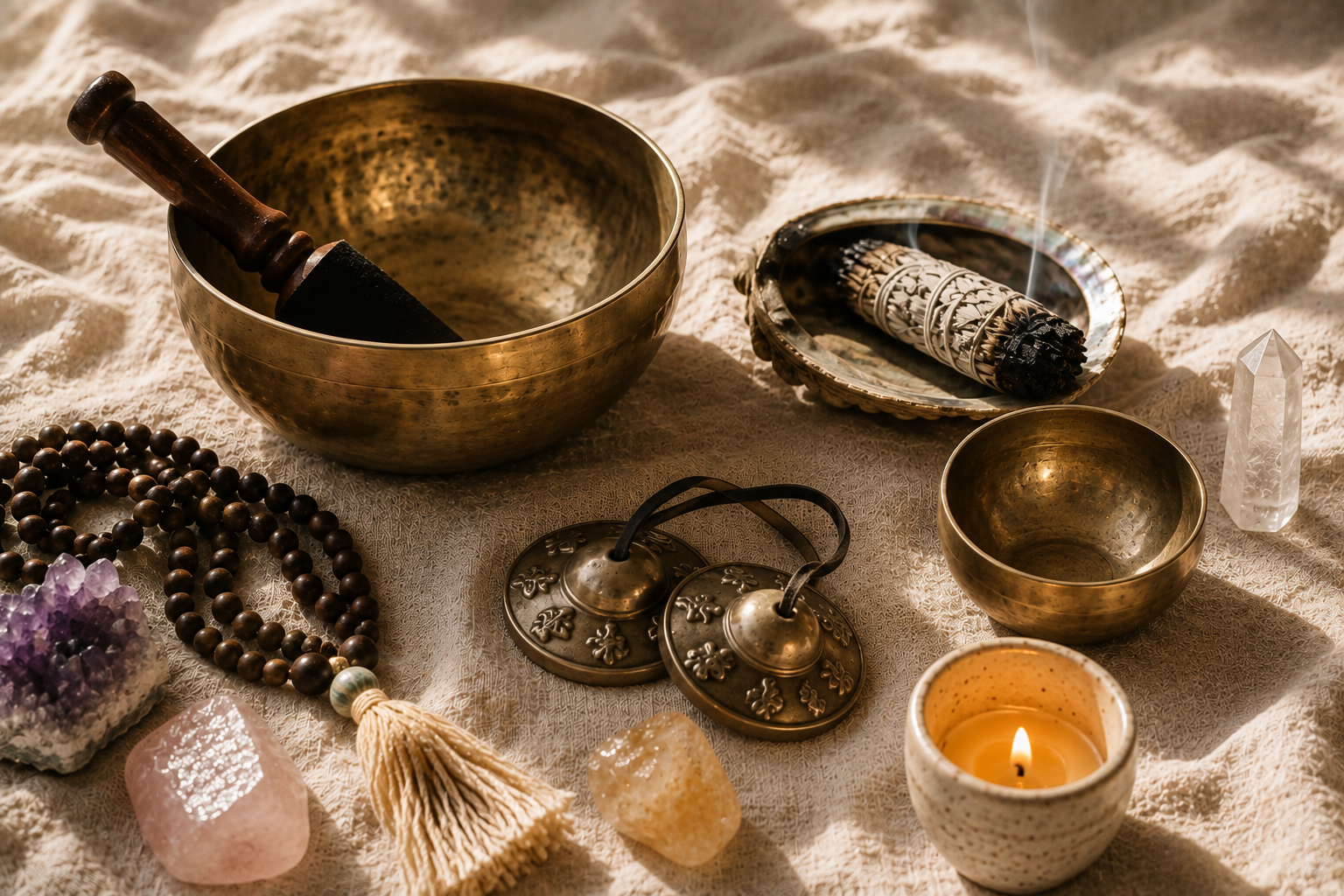
There are moments when words stop helping.
Your thoughts keep circling. Your shoulders stay tense. Your heart races for reasons you can't explain.
Then someone strikes a singing bowl.
Or a choir begins to sing.
Or your favorite song comes on in the car and suddenly...you exhale.
Long before humans understood cortisol, the vagus nerve, or the nervous system, we understood something else:
Sound changes us.
Today, science is beginning to explain why.
a practice older than civilization
Sound healing is older than civilization itself.
Nearly every culture has used sound as part of healing or spiritual practice.
Ancient Egypt used chanting in temple ceremonies.
Indigenous cultures across the world incorporated drumming into healing rituals.
Ancient Greece believed music could restore emotional balance. Pythagoras explored mathematical relationships between musical intervals and believed harmony reflected the order of nature.
In Tibet and Nepal, singing bowls have been used for centuries during meditation and religious ceremonies.
Gregorian monks filled cathedrals with resonant chants.
Across history, people consistently noticed the same thing:
Certain sounds seemed to create calm.
what is sound healing?
Sound healing is an umbrella term for practices that intentionally use vibration, music, rhythm, or resonance to promote relaxation and well-being.
This might include:
- Tibetan singing bowls
- Crystal singing bowls
- Gongs
- Tuning forks
- Drumming
- Chanting
- Vocal toning
- Guided meditation with music
- Nature sounds
- Instrumental music
Some practitioners also use low-frequency vibration placed directly on the body, known as vibroacoustic therapy.
why does sound affect us?
Everything you hear is vibration.
Your ears convert those vibrations into electrical signals that your brain interprets as sound.
But hearing isn't just about your ears.
Music influences multiple systems at once:
- your emotional centers
- your autonomic nervous system
- heart rate
- breathing
- stress hormones
- attention
- memory
This is why one song can instantly transport you back to childhood.
Or make you cry.
Or make you dance in your kitchen.
what does the science actually say?
Research around music and sound therapy has grown dramatically over the last two decades.
Studies consistently show that music-based interventions may help reduce stress, anxiety, perceived pain, and improve mood in many settings, although effects vary by person and condition.
Researchers think several things may be happening:
- breathing naturally slows
- heart rate decreases
- muscles relax
- attention shifts away from distress
- the nervous system receives cues of safety
The experience becomes less about "fixing" your body and more about creating conditions where your body can recover.
what about singing bowls?
This is where things get interesting.
Early research suggests singing bowl sessions may reduce anxiety, tension, and stress for some people.
However...
Most studies are still relatively small.
Researchers believe the benefits may come from a combination of:
- deep relaxation
- focused attention
- pleasant sound
- gentle vibration
- meditation
Rather than one magical frequency.
what about "healing frequencies?"
You've probably seen videos claiming things like:
528 Hz repairs DNA.
741 Hz removes toxins.
963 Hz activates your pineal gland.
At this point, there is no strong scientific evidence supporting these specific claims. Reviews have found that the commonly promoted "Solfeggio frequencies" are not backed by high-quality clinical evidence for effects like detoxification or DNA repair.
That doesn't mean listening is harmful.
It simply means we should separate personal experience from scientific proof.
If a certain sound helps you relax, meditate, or fall asleep...
That's valuable.
It doesn't have to repair your DNA to improve your evening.
simply listen
Sometimes healing is simply feeling safe enough to breathe.
One of the beautiful things about sound is that it asks almost nothing of you.
You don't need to "do it right."
You don't need experience.
You don't need flexibility.
Sometimes you simply sit...
...listen...
...and allow your nervous system to settle.
where to find trustworthy recordings
Instead of searching for miracle frequencies, look for recordings created by experienced musicians, meditation teachers, or sound practitioners.
Some wonderful places to explore include:
- YouTube recordings of Tibetan singing bowls and crystal bowls from established practitioners
- Insight Timer (thousands of free guided meditations and sound sessions)
- Meditative Mind (long-form ambient meditation music)
- The Honest Guys (guided relaxation)
- Sound bath recordings from licensed music therapists or experienced sound practitioners
Nature recordings can be just as powerful:
- rainfall
- ocean waves
- forest sounds
- birdsong
- gentle rivers
Sometimes the oldest soundtrack is still the best one.
a gentle reminder
You don't have to believe that every frequency carries mystical powers to appreciate what sound can do.
Music has comforted grieving families.
Drums have united communities.
Lullabies have helped babies sleep.
Choirs have filled sacred spaces for centuries.
Your favorite song has probably carried you through something difficult.
Whether you call it neuroscience...
meditation...
or simply being human...
there is healing in that.
At Heart Body Spirit, we believe healing doesn't have to be mysterious to be meaningful. If a practice helps you feel more grounded, more present, and more connected to yourself — while staying curious about the evidence — it deserves a place in your wellness toolkit.
Explore Topics
share this post
Written by
Shannon
Sharing through writing about trauma healing, nervous system regulation, yoga, reiki, holistic nutrition, and PCOS — through a trauma-informed lens.